
Commercial Playground Equipment Regulations and Safety Standards: Comprehensive Guide for Compliance and Accessibility

Playground safety regulations and standards define the technical and operational requirements that reduce injury risk, ensure legal compliance, and enable inclusive play for children of every ability. This guide explains the core ASTM standards, the Consumer Product Safety Commission (CPSC) guidance, and the 2010 Americans with Disabilities Act (ADA) provisions that together shape commercial playground compliance. Readers will learn how impact attenuation and critical fall height drive surfacing selection, how inspection and maintenance programs support ongoing safety, and which local permitting steps commonly affect projects in Charlotte, NC and Charleston, SC. Practical checklists, comparison tables, and implementation steps make it easier for facility managers, municipal planners, school administrators, and HOAs to translate standards into compliant designs. The article also shows how a turnkey approach to design, permitting, installation, testing, and maintenance helps deliver ADA-compliant, safety-tested playgrounds while preserving community goals and sustainability.

Commercial Playground Safety Standards, Compliance and Accessibility
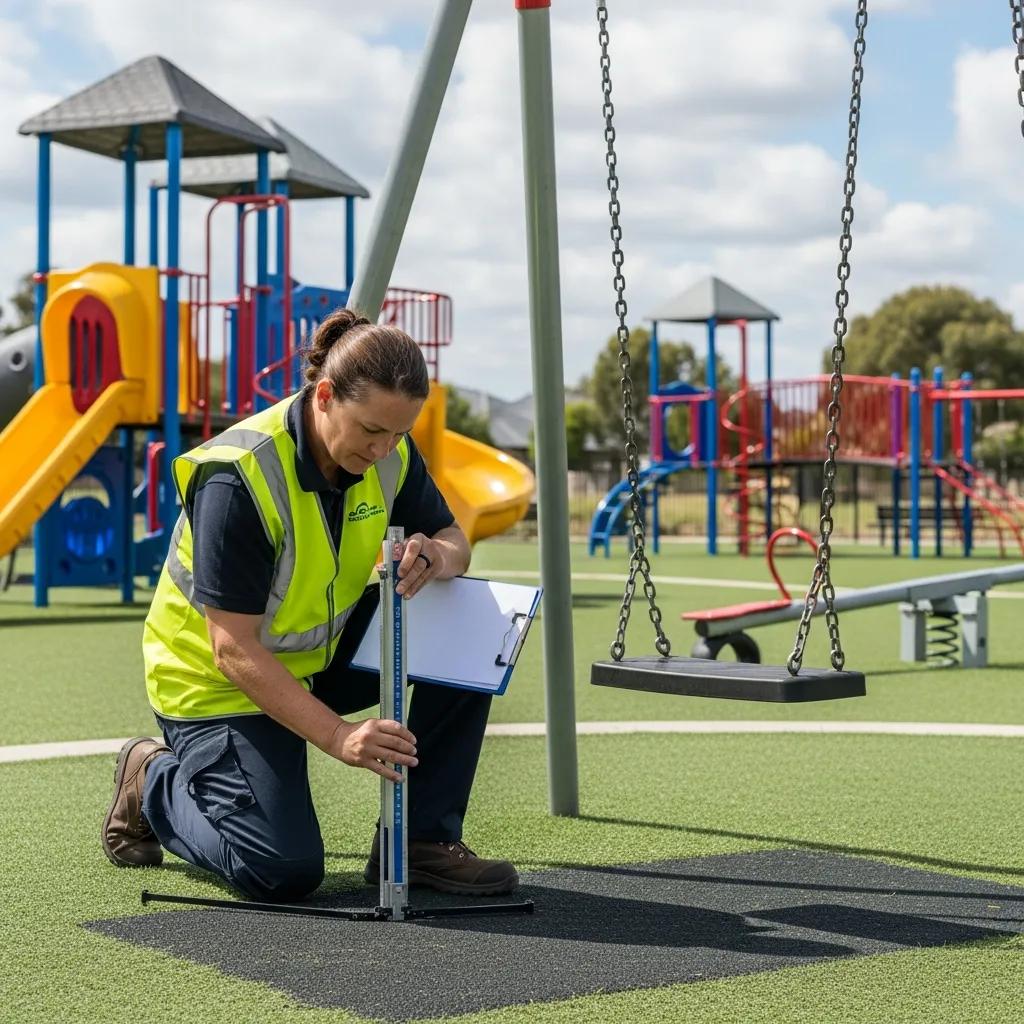
Inspector evaluating playground safety compliance, measuring impact attenuation of surfacing near swings, with colorful playground equipment in the background.

ASTM International produces consensus standards that set performance and test requirements for public playground equipment and surfacing to reduce entrapment, structural failure, and impact injuries. These standards are technical specifications used by manufacturers, specifiers, and inspectors to test equipment strength, surfacing impact attenuation, and accessibility performance. Applying ASTM standards during selection, installation, and acceptance testing reduces liability and creates clear benchmarks for inspection and maintenance. Below is a concise mapping of the primary ASTM standards, their scope, and practical implementation notes to guide design and procurement decisions.

Understanding ASTM F1487: Public Use Playground Equipment Safety Requirements

ASTM F1487 defines performance and safety requirements for public-use playground equipment by addressing structural integrity, entrapment protection, projecting and sharp edges, and required clearance around moving parts. The standard requires manufacturers and installers to design use zones and barriers that limit predictable risky behavior while providing clear labeling and installation instructions for owners. For practical application, project teams use F1487 to size use zones, verify guardrails and openings meet entrapment criteria, and confirm assembly instructions align with as-built conditions. Understanding these clauses helps municipalities and HOAs create procurement specifications that buyers and installers can validate during inspection and handover.

StandardScopePractical Implementation
ASTM F1487Public use playground equipment performance and constructionUse for equipment procurement specs, entrapment checks, and installation verification
Guardrail & Opening CriteriaLimits on openings and guardrail heightsApply to elevated platforms and transfer systems to prevent falls and entrapment
Labeling & InstructionsManufacturer-provided warnings and maintenance instructionsUse as basis for owner manuals and inspection checklists

This summary clarifies how F1487 converts into field checks, enabling project teams to verify compliance before public use and to document acceptance criteria for future inspections.

How ASTM F1292 and F1951 Ensure Impact Attenuation and Accessibility

ASTM F1292 specifies laboratory test methods to measure impact attenuation of playground surfacing systems; results translate into a Critical Fall Height (CFH) that determines required surfacing depth under play equipment. ASTM F1951 provides procedures for evaluating surface systems for accessibility, measuring mobility device performance over surfacing. Together, F1292 and F1951 inform both safety (impact attenuation) and ADA-related accessibility outcomes, so specifiers must select surfacing with appropriate CFH ratings and proven accessibility metrics. Interpreting lab reports requires matching tested compaction, depth, and installation method to the field condition; discrepancies between lab and field often arise from improper installation or insufficient maintenance.

Test / StandardPurposeField Consideration
ASTM F1292Impact attenuation testing, CFH ratingEnsure installed depth matches tested conditions; verify compaction and drainage
ASTM F1951Accessibility testing for mobility devicesConfirm that the installed surface meets mobility device performance used in the ADA evaluation
Maintenance ImpactsLong-term performance changesPlan maintenance to preserve CFH and accessibility over service life

Understanding how to read F1292/F1951 results enables owners to match surfacing choices to both the equipment’s maximum fall heights and to the accessibility expectations of the 2010 ADA Standards.

How Do CPSC Guidelines Enhance Public Playground Safety?

Team conducting a playground safety audit, reviewing plans and discussing compliance with ASTM and CPSC guidelines, with playground equipment and safety surfacing in the background.

The CPSC Public Playground Safety Handbook provides non-mandatory but widely accepted guidance that complements ASTM performance standards by focusing on practical design, operations, and inspection recommendations for safer public playgrounds. The Handbook offers design advice on use zones, surfacing, and equipment layout, and operational guidance for establishing inspection and maintenance routines that prolong surfacing performance and reduce hazards. Facility managers often combine CPSC recommendations with ASTM test reports and ADA requirements to create a comprehensive safety program that covers design, installation, and day-to-day asset management.

What Are the Core Recommendations in the CPSC Public Playground Safety Handbook?

The CPSC Handbook emphasizes predictable, measurable measures that reduce risk through design and operation, focusing on fall surfacing, adequate use zones, hazard elimination, and appropriate supervision strategies. It recommends surfacing that meets impact attenuation beneath and around equipment, clear fall zones free of trip hazards, and removal or mitigation of strangulation or entanglement hazards. The guidance also addresses equipment selection by age group and encourages signage and sightline considerations to support supervision.

These recommendations are commonly translated into procurement checklists and inspection criteria by municipalities and schools, creating a bridge between design intent and daily safety practices.

  1. Provide compliant fall surfacing that matches equipment critical fall heights and extends under use zones.
  2. Design and maintain clear use zones free of obstacles and trip hazards to minimize fall impacts.
  3. Eliminate entanglement and entrapment hazards through part sizing, closures, and guardrail design.

Applying these recommendations at the design stage simplifies later maintenance and inspection tasks while improving overall user safety and supervision effectiveness.

How to Implement CPSC Maintenance and Inspection Guidelines Effectively

Effective implementation of CPSC maintenance guidance requires a documented inspection schedule, a prioritized defects log, and clear remediation procedures tied to safety-critical items such as surfacing depth and equipment integrity. A practical program includes daily visual checks for obvious hazards, weekly operational checks of high-use components, and annual professional assessments that may include surfacing re-testing and equipment re-certification by qualified inspectors. Documentation should capture findings, remediation dates, and responsible parties to support risk management and to demonstrate due diligence during audits. Regular maintenance preserves impact attenuation and accessibility performance, which ties directly back to ASTM and ADA compliance requirements.

  • Daily: Visual sweep for debris, vandalism, and obvious hazards.
  • Weekly: Check moving parts, fasteners, and surfacing depth in high-traffic areas.
  • Annually: Full professional inspection, surfacing testing, and corrective action plan.

Consistent record-keeping builds institutional memory, helps allocate maintenance budgets prudently, and ensures that surfacing and equipment continue to meet safety and accessibility expectations.

For organizations seeking operational support, Shade and Play Pros integrates CPSC maintenance and inspection guidance into its maintenance offerings, providing scheduled inspections, surfacing checks, and remediation coordination to help facilities sustain compliance and document safety efforts. Their approach operationalizes handbook recommendations into repeatable inspection workflows and prioritized service actions without replacing the owner’s final responsibility for safety.

What Are the ADA Playground Accessibility Requirements and Inclusive Design Principles?

The 2010 ADA Standards for Accessible Design set technical requirements for accessible routes, ground conditions, and transfer provisions that apply to many playground installations, aiming to ensure children with disabilities can approach, enter, and experience play areas. ADA requirements focus on accessible routes to play components, stable and firm surfacing in required areas, appropriate clearances at play components, and the availability of ground-level and transfer-accessible play features. Beyond minimum compliance, inclusive design principles emphasize social integration, sensory engagement, and a range of physical and cognitive challenges so that play environments promote participation for children of differing abilities. The next subsections map ADA clauses to playground elements and list inclusive features practitioners should consider.

How Do the 2010 ADA Standards for Accessible Design Apply to Playgrounds?

Key ADA provisions that commonly apply to playgrounds include requirements for accessible routes from parking/entries to play components, surface firmness and stability in the accessible route and use zones, and measurable clearances at play elements to permit transfers and approach by mobility devices. Practically, designers must ensure that a percentage of play components are located on accessible routes, that surfacing passes mobility device testing, and that transfer systems and ground-level activities provide comparable play value. Mapping the ADA clauses to design deliverables helps teams produce compliance checklists for plan review and final inspection, reducing the risk of noncompliance at occupancy.

  • ADA clause → Playground element → Compliance checklist
  • Accessible route → Pathways to play components → Firm, stable surfacing & slope limits
  • Transfer systems → Elevated play components → Reach and landing clearances

Translating ADA criteria into measurable design and installation tasks allows owners to document compliance and to plan for inclusive play that goes beyond baseline requirements.

What Inclusive Features Promote Equal Access for Children of All Abilities?

Inclusive playgrounds combine ADA-required accessibility with design features that support social interaction, sensory stimulation, and varied motor skills practice to make play meaningful for a broad range of users. Features that promote inclusivity include ground-level play modules, accessible swings and transfer platforms, sensory-rich panels and musical elements, clear wayfinding, and adaptable routes that accommodate caregivers and mobility devices. These design choices improve developmental outcomes and encourage shared play experiences, while retaining compliance with safety and surfacing standards. Selecting inclusive features early in the design process ensures they are properly integrated with surfacing, drainage, and use-zone planning for both safety and accessibility.

  1. Ground-level play modules: Provide play opportunities without requiring transfers or climbing.
  2. Adaptive swings and transfer platforms: Enable children with mobility impairments to access swinging and elevated play.
  3. Sensory panels and musical elements: Support children with sensory processing differences and enrich social play.

Incorporating inclusive features requires coordination between accessibility criteria and ASTM/CPSC safety measures so that safety and access goals reinforce each other.

Which Playground Safety Surfacing Regulations Must Be Followed?

Surfacing selection hinges on two regulatory priorities: impact attenuation (to reduce injury severity from falls) and accessibility (to permit mobility device access where required). Critical Fall Height (CFH) ratings from ASTM F1292 determine the required surfacing type and depth beneath equipment, while ASTM F1951 and ADA guidance inform whether the surface provides an accessible route and use-zone access. Selecting surfacing also requires evaluating lifecycle costs, maintenance frequency, drainage, and seasonal performance to ensure long-term compliance and user satisfaction. The subsections below compare common surfacing options and explain how CFH maps to surfacing depth and use zones.

What Are the Differences Between Engineered Wood Fiber and Poured-in-Place Rubber Surfacing?

Engineered Wood Fiber (EWF) and Poured-in-Place (PIP) rubber represent common surfacing approaches that differ in installation, accessibility, maintenance, and lifecycle cost. EWF generally offers lower upfront cost and good impact attenuation when properly installed and maintained, but it requires frequent topping and grading to maintain CFH and does not always meet accessibility measures without compacting or stabilizing. PIP rubber delivers stable, accessible surfaces that meet ASTM F1951 mobility device criteria and require less routine topping, but it carries higher initial material and installation costs and requires professional installation to match tested lab conditions. Choosing between them depends on budget, accessibility objectives, maintenance capacity, and desired longevity.

Surface TypeASTM ComplianceInstallation Depth / Notes
Engineered Wood Fiber (EWF)Can meet F1292 when installed at specified depthsRequires 6–12+ inches depending on CFH; frequent maintenance to retain depth
Poured-in-Place (PIP) RubberTypically meets F1292 and F1951 when tested as a systemInstalled to manufacturer-specified depth and base; offers immediate ADA accessibility
Rubber MulchMay meet F1292 under controlled installationLoose-fill product requiring containment and periodic topping

Choosing surfacing requires matching the tested system to field installation and planning maintenance to preserve the tested performance over time.

Shade and Play Pros has experience installing both EWF and PIP systems as compliant surfacing solutions for community and commercial projects, and their project teams evaluate trade-offs between lifecycle cost, accessibility goals, and maintenance budgets to recommend the appropriate system for each site.

How Does Critical Fall Height Determine Surfacing Depth and Use Zones?

Critical Fall Height (CFH) is the maximum fall distance from which a surface system meets impact attenuation criteria under ASTM F1292 testing; designers use CFH to set minimum surfacing depth and to size use zones around equipment. Field application requires converting CFH to required loose-fill depth or to PIP thickness per manufacturer’s installation instructions, and accounting for compaction, drainage, and expected settlement over time. Use zones must extend beyond equipment edges according to equipment manufacturer recommendations and CPSC guidance so that impact surfaces cover probable falling trajectories. Proper documentation of installed depth and periodic measurements during inspections ensure that surfacing continues to meet CFH goals.

  1. Measure equipment maximum fall height and reference CFH requirements from testing.
  2. Install surfacing to the tested depth and base conditions specified in lab reports and manufacturer instructions.
  3. Monitor and maintain surfacing depth through scheduled inspections and replenishment where necessary.

Accurately applying CFH data prevents under-surfacing and helps owners prioritize maintenance actions that preserve both impact attenuation and accessibility.

What Local Regulations and Permitting Processes Affect Commercial Playgrounds in Charlotte, NC and Charleston, SC?

Local permitting and code requirements vary by jurisdiction and often add administrative steps beyond ASTM, CPSC, and ADA compliance. Typical municipal reviews assess site safety, accessibility routes, drainage, and sometimes specific materials or fencing requirements; timelines depend on permit types and departmental workload. Understanding the common permit types, required documentation, and expected review timelines reduces delays and cost surprises when planning a community playground. Below is an operational table mapping local jurisdiction touchpoints, typical permit types, and practical submission requirements for Charlotte-Mecklenburg and Charleston County to assist project planners.

JurisdictionPermit / Review TypeTypical Requirements / Timeline
Charlotte-MecklenburgSite plan review & building/permit reviewSubmissions often include layout, surfacing spec, ADA accessibility plan, drainage; timeline varies with scope
Charleston CountyPermit and inspection coordinationRequires detailed plans for equipment placement, surfacing, and inspections; allow time for county scheduling
Common DeliverablesDrawings, specifications, maintenance planInclude equipment spec sheets, surfacing test reports, and inspection/maintenance schedules

This mapping helps owners prepare complete submissions and anticipate timelines for municipal approvals and inspections.

Shade and Play Pros provides local permitting support in Charlotte and Charleston by preparing permit-ready documentation, coordinating plan submissions, and communicating with permitting authorities as part of their turnkey project management offering. This support helps clients reduce administrative burden and align project schedules with local review cycles.

What Are the Charlotte-Mecklenburg Playground Codes and Compliance Requirements?

Charlotte-Mecklenburg oversight typically focuses on ensuring safe public use through required site plans, surfacing compliance, and adherence to ADA accessibility routes; local departments may evaluate drainage, fencing, and proximity to streets or drop-offs. Project applicants should provide equipment layout drawings, surfacing specifications linked to ASTM F1292/F1951 test reports, ADA route diagrams, and a maintenance plan that references inspection schedules. Common pitfalls include incomplete surfacing documentation, unclear accessible route connections, and omission of maintenance commitments. Preparing a consolidated submission with clear compliance cross-references speeds municipal review and inspection scheduling.

  • Permit checklist: plan set, surfacing specs, ADA route plan, maintenance/inspection schedule.
  • Common issue: mismatch between tested surfacing conditions and proposed field installation.

Careful pre-submission QA reduces review comments and expedites the permit-to-construction timeline for municipal and HOA clients.

How to Navigate Charleston County Playground Permitting and Inspection Procedures

Charleston County permitting typically requires a clear demonstration of safety measures, surfacing compliance, and accessible routing, along with site grading and drainage documentation where applicable; reviewers often request manufacturer specs and surfacing test data as part of the file. Applicants should allow time for county review cycles and prepare to respond to inspection checklists that confirm installed conditions match submitted drawings. Common compliance hurdles include inadequate surfacing containment, missing transfer platform details, and insufficient documentation of inspection schedules. Adopting a project workflow that includes early engagement with county reviewers and pre-installation submittals prevents rework and schedule delays.

  1. Prepare complete documentation including equipment specifications, surfacing test reports, and ADA route diagrams.
  2. Schedule pre-construction review with county authorities where possible to clarify expectations.
  3. Document inspections and corrective actions to demonstrate compliance at final inspection.

Proactive coordination with local authorities shortens permit cycles and reduces change orders during installation.

How Does Shade and Play Pros Ensure Compliance with Safety and Accessibility Standards?

Shade and Play Pros delivers turnkey playground services that integrate design, permitting support, professional installation, and post-installation testing to achieve ASTM, CPSC, and ADA alignment for commercial and community projects. Their approach emphasizes project management workflows that move projects from site assessment through design documentation, permit submission, installation by fully licensed and insured installers, and final testing that confirms surfacing CFH and accessibility performance. The company focuses on customizable outdoor solutions for municipalities, HOAs, schools, and commercial properties in Charlotte, NC, Charleston, SC, and surrounding counties, and offers sustainability-minded options and community engagement during design to align projects with local goals. The description below outlines the firm’s phased delivery model, QA steps, and two concise local case summaries that illustrate measurable compliance outcomes.

What Is the Turnkey Project Management Approach for Safe Playground Installation?

Project PhaseKey TasksDeliverable
Site AssessmentSafety audit, measurements, constraintsSite assessment report
Design & PermittingEquipment layout, surfacing specs, permit submissionsPermit-ready drawings
Installation & QALicensed installers, surfacing install, testingTest reports, maintenance plan

This phased workflow clarifies responsibilities at each stage and provides owners with traceable evidence of compliance and performance.Can You See Case Studies Demonstrating ADA and ASTM Compliance in Local Projects?

Case Study 1 — Community Park Upgrade: A municipal playground replacement required compliant surfacing for equipment with a high CFH and improved accessible routes to ground-level play. Shade and Play Pros developed specifications matching ASTM F1292/PIP test conditions, coordinated local permit submissions, and managed installation and CFH verification tests to validate the installed system. The outcome preserved accessibility and provided documented test reports for municipal acceptance.

Case Study 2 — School Playground Retrofit: A school needed to add inclusive ground-level components and ensure accessible connections from the campus pathway. The project included ADA mapping of accessible routes, selection of a surfacing system tested to ASTM F1951, and scheduling of inspections aligned with local permitting requirements. The result delivered accessible play opportunities and a maintained inspection schedule to preserve both safety and accessibility.

These case summaries demonstrate how a structured, standards-driven process reduces risk and produces verifiable compliance outcomes while enabling inclusive play for diverse user populations. If you need assistance translating regulations into a deliverable project plan, Shade and Play Pros offers consultative support and turnkey delivery for compliant, community-focused playground projects.