Step-by-Step Guide to Ensuring Playground Equipment Meets Safety Standards in North Carolina

Ensuring that playground equipment meets safety standards in North Carolina begins with understanding the specific regulations, performing thorough site evaluations, selecting compliant materials, and maintaining ongoing inspections to protect children and reduce liability. How do I ensure playground equipment meets safety standards in North Carolina? This guide delivers comprehensive, step-by-step strategies—from key regulatory bodies and national guidelines to practical inspection tools, surfacing requirements, ADA compliance, and risk management considerations—while illustrating how Shade and Play Pros’ expertise can streamline every phase of your project. You will learn to navigate DCDEE rules, incorporate CPSC and ASTM specifications, conduct site hazard assessments, choose proper surfacing, schedule professional inspections, apply accessibility standards, and manage legal responsibilities. These themes create a unified framework that supports municipalities, schools, parks and recreation departments, commercial property owners, HOAs, and developers in building and sustaining safe, inclusive playgrounds.

What Are the Key Playground Safety Standards in North Carolina?

Key playground safety standards in North Carolina define mandatory requirements and testing protocols to minimize injuries by specifying performance, design, surfacing, and accessibility criteria for all public and licensed childcare facilities.

Which North Carolina Regulations Govern Playground Safety?

North Carolina playground safety regulations are enforced under the Division of Child Development and Early Education (DCDEE) through 10A NCAC 09 .0605, which prescribes equipment height limits, protective surfacing depths, and entrapment prevention measures for licensed childcare centers.

Key state mandates include:

  • Protective surfacing under equipment over 18 inches in height
  • Minimum 6 feet of impact-attenuating material in all directions
  • Openings sized to prevent head or limb entrapment (less than 3.5 inches or greater than 9 inches)

North Carolina Playground Safety Regulations

The Division of Child Development and Early Education (DCDEE) in North Carolina enforces playground safety regulations through 10A NCAC 09 .0605, which outlines specific requirements for licensed childcare centers. These regulations cover equipment height limits, surfacing depths, and measures to prevent entrapment, ensuring a baseline level of safety across the state.

North Carolina Division of Child Development and Early Education, 10A NCAC 09 .0605

This regulation is directly relevant as it is the primary source of playground safety standards in North Carolina, as stated in the article.

These state rules establish a foundation for consistent safety across North Carolina facilities, leading into how national standards augment these requirements.

How Do CPSC and ASTM Standards Apply to NC Playgrounds?

CPSC and ASTM standards complement state regulations by providing voluntary consensus specifications and performance testing protocols that enhance equipment safety and durability.

  • CPSC Public Playground Safety Handbook offers best practices for fall zone dimensions and inspection procedures
  • ASTM F1487 specifies consumer safety performance for public-use equipment
  • ASTM F1292 defines impact attenuation requirements for playground surfacing

ASTM Standards for Playground Equipment

ASTM International (formerly known as the American Society for Testing and Materials) develops voluntary consensus standards for playground equipment, including performance testing protocols. These standards, such as ASTM F1487 for public-use equipment and ASTM F1292 for surfacing, complement state regulations by providing benchmarks for safety and durability.

ASTM International, ASTM F1487, ASTM F1292

This citation supports the article’s discussion of how national standards, specifically those from ASTM, enhance playground safety in North Carolina.

Adopting these industry standards ensures equipment not only meets North Carolina codes but also aligns with nationally recognized safety benchmarks, enabling a seamless transition into accessibility obligations.

What Are the ADA Requirements for Accessible Playgrounds in North Carolina?

Mother supporting child on playground monkey bars, emphasizing safety and accessibility in play environments.

ADA requirements mandate accessible design features so children of all abilities can use playgrounds safely and independently. An accessible playground must include firm, stable routes to play components, transfer systems for elevated activities, and ADA-compliant surfacing that supports wheelchairs. These accessibility mandates integrate with safety surfacing requirements, forming a cohesive design approach that balances universal usability with protective impact attenuation.

Step-by-Step Compliance Guide: NC Playground Equipment Safety

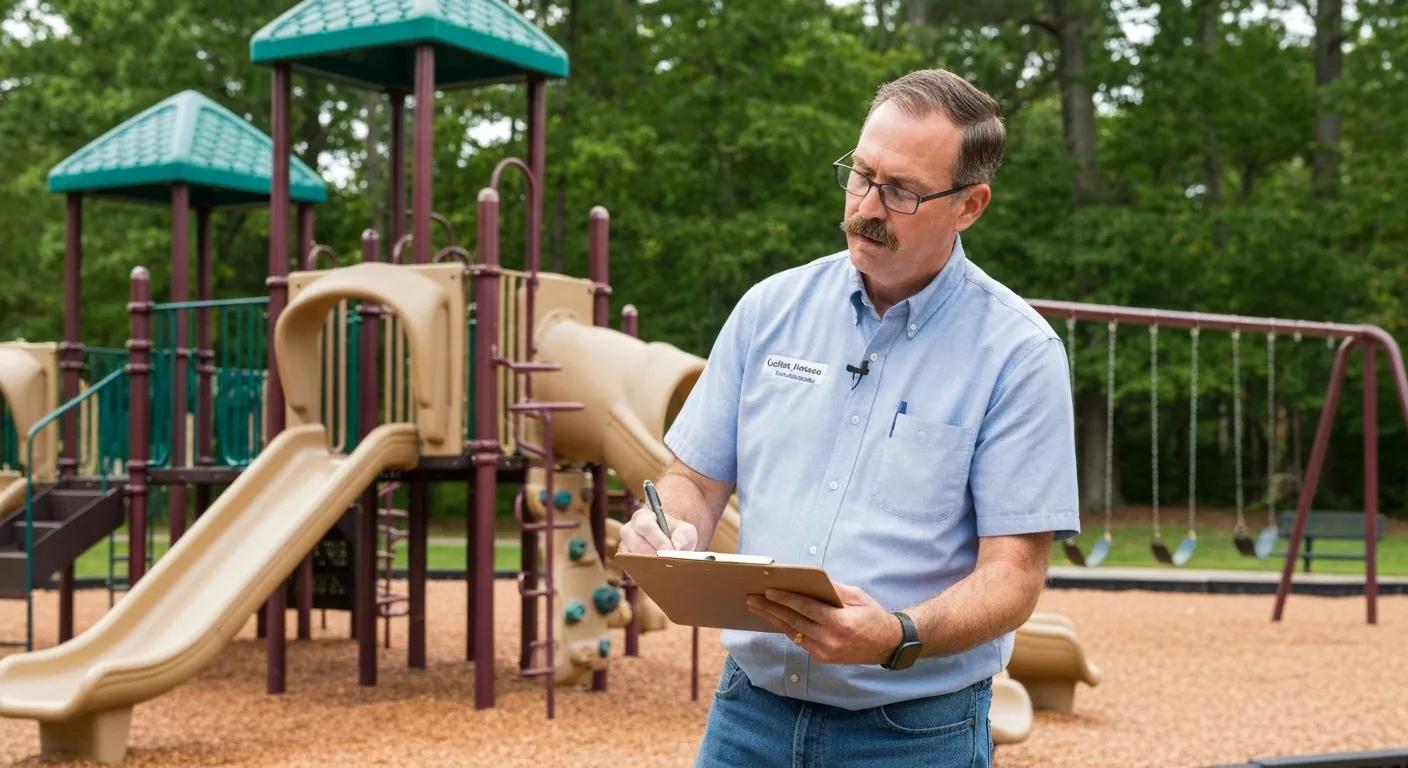
Man conducting a playground safety assessment, taking notes on clipboard, with playground equipment including slides and swings in the background, emphasizing compliance with safety standards and accessibility in North Carolina.

An initial playground safety assessment defines project scope, identifies hazards, and guides compliance planning by evaluating site conditions, potential risks, and resource needs in a single comprehensive audit.

What Site Factors Affect Playground Safety and Compliance?

Site factors directly influence playground safety audit outcomes and include age-appropriateness of equipment, geographic location considerations, and the accessibility of routes and amenities. Key elements are:

  • Age group designations for equipment safety
  • Shade structures to mitigate heat exposure
  • Accessible entrances, parking, and rest areas

Assessing these variables early ensures that design and installation phases align with regulatory, functional, and environmental requirements, preparing the project for hazard identification.

How Do You Identify Potential Hazards During Site Assessment?

Effective hazard identification relies on systematic observation and risk evaluation to detect issues such as:

  1. Protrusion and entanglement hazards from exposed hardware
  2. Surface deterioration, compaction, or debris in fall zones
  3. Inadequate spacing between equipment components

Flagging these concerns informs prioritized remediation plans, connecting directly to the selection of tools and checklists that support accurate evaluations.

A reliable audit combines DIY checklists based on CPSC guidelines with professional Certified Playground Safety Inspector (CPSI) assessments. Essential tools include:

  • Impact attenuation testers for surfacing materials
  • Entrapment probes for openings
  • CPSC-based digital inspection forms

Integrating these resources ensures that both visual and technical inspections meet or exceed North Carolina and national standards, setting the stage for compliant equipment selection.

How Should Playground Equipment Be Selected and Installed to Meet NC Safety Standards?

Selecting and installing playground equipment according to North Carolina safety standards requires verified certifications, proper anchoring, and adherence to spacing guidelines to ensure stability and safe use.

What Certifications Should Playground Equipment Have?

Equipment TypeCertification StandardCompliance Benefit
Commercial Play StructureASTM F1487 & IPEMA CertifiedVerified structural integrity and component safety
Safety Surfacing MaterialASTM F1292 Impact TestConfirmed shock absorption for critical fall heights
Adaptive Play ComponentADA Compliant (ICC/ANSI A117.1)Ensured accessibility and support for children with disabilities

This certification matrix helps decision-makers select products that automatically satisfy both state and national requirements, guiding installation best practices.

How Is Proper Equipment Anchoring and Spacing Ensured?

Proper anchoring secures equipment to prevent tipping and displacement, while maintaining recommended clear zones reduces collision and entrapment risks. Key guidelines:

  • Anchor foundation design based on manufacturer specifications
  • Maintain 6 feet of clearance between adjacent play components (not 9 feet)
  • Install barrier-free zones to accommodate safe approaches

These installation practices uphold safety performance standards and prepare grounds for surfacing considerations.

What Are Entrapment and Entanglement Hazards to Avoid?

Equipment design must eliminate openings and projections that can trap body parts or snag clothing. Avoidable hazards include:

  • Gaps between rails or panels narrower than 3.5 inches
  • Exposed bolt ends and sharp edges
  • Straps, ropes, or chains that exceed safe loop diameters

Proactive hazard elimination in design and installation solidifies compliance and smoothly transitions to surfacing requirements.

What Are the Playground Surfacing Requirements in North Carolina?

Playground surfacing requirements in North Carolina define approved materials, minimum depths, and fall zone dimensions to cushion falls and reduce injury severity on all public and licensed facility playgrounds.

Which Protective Surfacing Materials Are Approved in NC?

Approved surfacing options offer measured impact attenuation and drainage characteristics suitable for different budgets and aesthetics. Key materials include:

  • Engineered wood fiber for loose-fill cushioning
  • Poured-in-place rubber for seamless, ADA-accessible surfaces
  • Rubber mulch and interlocking tiles for high-impact areas
  • Pea gravel and sand in low-traffic, licensed child care settings

These material choices balance performance, maintenance, and accessibility, supporting precise depth requirements.

How Deep Should Playground Mulch or Surfacing Be?

The surfacing depth must correlate to the equipment’s critical fall height to maintain safety. Standard depths include:

  • Loose-fill wood fiber: 9 inches for 7 feet fall height
  • Rubber mulch: 6 inches for 6 feet fall height
  • Poured-in-place rubber: 2 inches minimum with appropriate underlayment

Calculating and installing the correct depth ensures impact attenuation continues to protect users as they explore the play environment.

How Are Fall Zones Defined and Measured Around Equipment?

Fall zones extend at least 6 feet beyond each piece of stationary equipment to provide adequate shock-absorbing coverage. A measured fall zone layout involves:

  1. Identifying the highest accessible component
  2. Marking a 6-foot perimeter around that point
  3. Verifying surfacing continuity within the entire boundary

This mapping process ties surfacing depth and layout into a cohesive protective system.

How Often Should Playgrounds Be Inspected and Maintained in North Carolina?

Regular inspections and maintenance protocols uphold safety standards, prevent deterioration, and reduce liability by ensuring equipment and surfacing remain in optimal condition.

What Is the Role of a Certified Playground Safety Inspector (CPSI) in NC?

A CPSI brings specialized training in equipment performance, surfacing impact testing, and regulatory requirements, enabling objective compliance assessments and detailed reporting. Their professional evaluation:

  • Identifies emerging hazards before incidents occur
  • Validates installation integrity and surfacing performance
  • Documents compliance for licensing and insurance purposes

Engaging a CPSI supports uninterrupted safety management and leads into setting inspection schedules.

Structured checklists and defined inspection frequencies ensure consistent oversight:

  • Daily: Visual safety sweep for obvious hazards
  • Monthly: Detailed component and surfacing review
  • Annual: Comprehensive CPSI-led audit including impact testing

This regimen optimizes preventive maintenance, reducing the need for costly repairs and aligning with NC regulations.

How Should Repairs and Hazard Corrections Be Documented?

Accurate record keeping demonstrates due diligence and protects against liability. Essential documentation practices involve:

  • Maintaining dated maintenance logs with corrective action details
  • Photographing before-and-after conditions
  • Storing CPSI inspection reports in a centralized file

These records form a transparent history of safety management, paving the way for ADA compliance efforts.

How Do You Ensure ADA Compliance for Playgrounds in North Carolina?

Ensuring ADA compliance integrates universal design principles, surfacing choices, and practical solutions to include children of all abilities in a safe play experience that meets state and federal mandates.

What Are the Accessible Design Principles for NC Playgrounds?

Accessible design principles require barrier-free routes, transfer platforms, and inclusive play components. Core guidelines include:

  • Minimum 36-inch-wide accessible pathways connecting all play activities
  • Transfer stations on elevated components to facilitate independent access
  • Ground-level, unisex play elements that encourage social interaction

Implementing these features ensures that accessibility remains central to safety planning, and they naturally influence surfacing decisions.

How Does ADA Surfacing Differ from General Safety Surfacing?

ADA surfacing must provide both impact attenuation and firmness to support mobility devices. Typical ADA-compliant surfacing includes:

  • Poured-in-place rubber with a firm, stable underlayer
  • Rubber tiles installed with interlocking seams
  • Engineered wood fiber compacted to meet firmness tests

These surfacing systems unify shock absorption with accessibility, reinforcing inclusive design approaches.

What Are Common ADA Compliance Challenges and Solutions?

Meeting ADA requirements can present site-specific challenges such as drainage, elevation changes, or budget constraints. Effective solutions involve:

  • Installing permeable paving under rubber surfacing to improve drainage
  • Utilizing ramps or graded slopes to connect raised play decks
  • Phasing inclusive features in project budgets to balance cost and compliance

Addressing these factors ensures universal access without compromising safety standards, leading into liability considerations.

What Are the Liability and Risk Management Considerations for NC Playgrounds?

Liability and risk management strategies protect organizations by demonstrating a standard of care through regular maintenance, documentation, and awareness of North Carolina’s legal context.

How Does Regular Maintenance Reduce Liability Risks?

Consistent upkeep minimizes hazards before they cause injury by preserving equipment integrity and surfacing performance. Regular maintenance:

  • Prevents surface compaction that compromises shock absorption
  • Detects wear and tear on high-traffic components
  • Reinforces a documented duty of care

Proactive maintenance practices underscore legal protection and transition into contributory negligence concepts.

What Is Contributory Negligence in North Carolina Playground Injury Cases?

Contributory negligence bars recovery if an injured party is found even partially at fault. Under NC law:

  • Any degree of plaintiff fault (even 1%) prevents compensation
  • Detailed documentation can demonstrate proper supervision and signage

Understanding this doctrine emphasizes the importance of meeting safety standards, informing insurance and risk transfer decisions.

How Can Municipalities, Schools, and HOAs Protect Themselves Legally?

Organizations can mitigate risk through:

  1. Securing general liability and premises insurance tailored to playground operations
  2. Retaining CPSI inspection reports as proof of ongoing compliance
  3. Posting clear safety rules and supervising use according to state guidelines

These risk management measures establish a robust legal defense and prepare the ground for selecting a qualified partner.

Why Choose Shade and Play Pros for Playground Safety Compliance in North Carolina?

Shade and Play Pros delivers turnkey playground solutions—from design and installation to inspection and maintenance—backed by local expertise and certified professionals, ensuring your project stays on schedule and fully compliant with NC regulations.

What Turnkey Solutions Does Shade and Play Pros Offer?

Our services encompass:

  • Custom playground design aligned to DCDEE, CPSC, ASTM, and ADA standards
  • Professional installation with licensed and insured crews
  • Scheduled CPSI inspections and corrective maintenance plans

This end-to-end approach ensures every detail meets safety requirements, easing administrative burdens.

How Does Local Knowledge Enhance Compliance and Response?

Based in Charlotte, NC, our team understands regional climate, regulatory updates, and logistical factors. Rapid response times and familiarity with local permitting requirements accelerate project delivery and maintain compliance.

What Certifications and Experience Do Our CPSI Inspectors Have?

Shade and Play Pros employs Certified Playground Safety Inspectors with extensive experience auditing public, school, and HOA facilities. Their specialized training and ongoing professional development reinforce our commitment to industry best practices and customer trust.

Implementing these steps establishes a comprehensive, defensible safety program that protects children, reduces organizational risk, and fosters inclusive play environments. Partnering with seasoned professionals ensures that every element—from regulations and inspections to surfacing and accessibility—works together seamlessly.

Request a consultation today to create or revitalize your North Carolina playground with confidence and precision.